
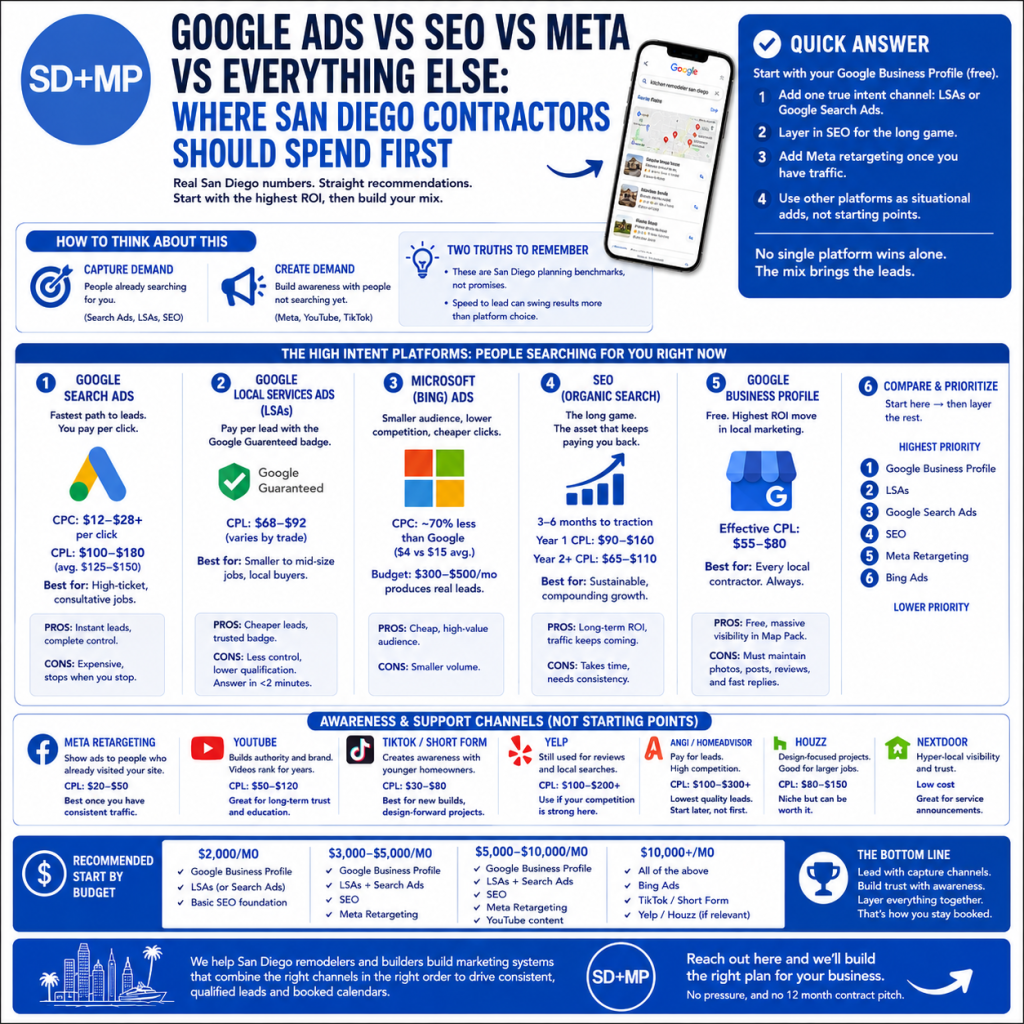
You’ve finally got real money to put into marketing, maybe $2,000 to $5,000 a month, and everyone’s telling you something different. Your web guy swears it’s SEO. The Google rep who keeps cold calling says Ads. Your buddy with one good month says “just post on Instagram.” So where contractors should advertise first is genuinely confusing, and most of the advice you’re getting is whatever that person happens to sell. This post sorts it out with real San Diego numbers and a straight recommendation by budget.
Quick Answer
Where contractors should advertise depends on budget and how fast they need leads, but the order rarely changes. Start with your Google Business Profile, which is free and the highest ROI move in local marketing. Then add one true intent channel: Google Local Services Ads for cheaper, faster leads on smaller jobs, or Google Search Ads for better qualification on premium remodels. Layer in SEO as the long game, since it’s the cheapest lead source by year two. Add Meta retargeting once you have site traffic, and treat YouTube, TikTok, Yelp, Angi, Houzz, and Nextdoor as situational adds, not starting points. No single platform wins alone, and the lead marketplaces like Angi are usually the worst place to start.
How to Think About This
Before the platforms, one framing that makes every decision easier. Marketing channels do one of two jobs: they capture demand that already exists, or they create demand that doesn’t yet. Search Ads, LSAs, and SEO capture people already looking for you. Meta, YouTube, and TikTok create awareness in people who aren’t searching yet. You need both eventually, but when budget is tight, you start with capture, because catching someone who’s already looking is far cheaper than convincing someone who isn’t.
A second truth worth saying out loud: the numbers below are San Diego planning benchmarks, not promises. Your actual cost per lead moves with your offer, your reviews, your landing page, and how fast you call people back. Speed to lead alone can swing your results more than your platform choice. Keep that in mind as we go.
The High Intent Platforms: People Searching for You Right Now
Google Search Ads
This is the fastest path to leads, full stop. Someone typing “kitchen remodeler San Diego” is ready to buy, and if you’re at the top, you get the call. In San Diego, clicks run roughly $12 to $28 for remodel keywords and higher for emergency work. Expect a cost per lead around $100 to $180, landing near $125 to $150 once you’re spending $3,000 a month.
The upside is control. You pick the keywords, the messaging, and the landing page, which is why Search wins for high ticket, consultative jobs where qualification matters. The downsides: it’s expensive, and the leads stop the moment you stop paying. One rule that doubles conversion rates: never send ad traffic to your homepage. If the ad is about kitchens, the click lands on a kitchen page built to book a consultation.
Google Local Services Ads (LSAs)
LSAs are the pay per lead option, and they come with the green Google Guaranteed badge that buyers trust. Instead of paying per click, you pay per lead, and in San Diego that runs about $68 to $92 for general remodeling, less for landscaping, more for design build. That’s often cheaper per lead than Search, and the badge does real work on trust. You can see how they work on Google’s Local Services Ads page.
The tradeoffs: less control and lower qualification. Lead quality has slipped as Google screens calls less aggressively, so you’ll field some “just getting a rough price” calls. Response time is everything here. Answering within two minutes can double your ranking. The smart play for many contractors is running LSAs and Search together, with LSAs catching low friction local buyers and Search capturing the specific, higher value searches LSAs miss.
Microsoft (Bing) Ads
Almost every contractor ignores Bing, and that’s a quiet opportunity. The audience is smaller, around 8 to 10 percent of San Diego search, but it skews older, richer, and less price sensitive, which is close to a perfect remodeling demographic. The clicks are dramatically cheaper too. Keywords that cost $15 on Google often run $4 on Bing, roughly 70 percent less, while converting at similar rates.
You can import your winning Google campaigns straight into Bing, drop the bids 30 to 50 percent, and run it nearly on autopilot. A budget of $300 to $500 a month produces real leads. It’s not a primary channel, but it’s some of the cheapest qualified search volume available.
SEO (Organic Search)
SEO is the long game and the asset play. It takes 3 to 6 months to gain traction and often won’t beat your paid channels on cost in year one. But here’s the math that matters. Spend $2,500 a month on ads for a year and you’ve spent $30,000, and the leads stop when you stop. Spend the same on SEO and by late in the year your cost per lead is dropping into the $65 to $110 range, and the traffic keeps coming after you ease off. By year two, it’s usually the cheapest lead source you own.
For remodelers, the winning pattern isn’t “rank the homepage.” It’s service page clusters, neighborhood pages where they make sense, project galleries, and case studies that show Google real depth. We break that structure down on our marketing for San Diego contractors page.
Google Business Profile
If you do one thing this week, do this. Your Google Business Profile is free, and for a local contractor it’s the highest ROI channel that exists, with an effective cost per lead in the $55 to $80 range once it’s maintained. Most contractors claim it, drop in a logo, and never touch it again, which is leaving money on the table every single day.
Photos, posts, review responses, correct categories, and fast replies all feed your ranking in the local map results, where a huge share of buyers now decide who to call. We go deep on the photo side in our Google Business Profile photo guide, because photo volume alone drives a measurable jump in phone calls.
The Awareness and Retargeting Platforms: People in Your Market, Not Searching Yet
Meta Ads (Facebook and Instagram)
Here’s where contractors waste the most money: trying to use Meta for cold lead generation. That’s not its strength. Meta’s sweet spot is retargeting, showing your best before and after project to people who already visited your site. Remarketing leads run about $25 to $40 and close far better than cold ones, because the person already knows you.
It’s also the best home for your visual work. Before and after slideshows beat single images, and a short narrated walkthrough roughly doubles the conversion of a photo carousel. If you’re spending over $500 a month on Meta, you need the Conversions API set up, since recent privacy changes cut tracking accuracy by about a third. More on the visual side in our piece on why before and after photos win more jobs, and broader social strategy on our small business marketing page.
YouTube Ads
YouTube is underused and works best as a remarketing engine, not a cold lead source. The play is sequencing: someone visits your site, then over the next week they see a 15 second clip of a similar finished project, then a testimonial, then a “why choose us” video. Cost per closed job from YouTube remarketing runs $350 to $800, lower than search, but it only works if you already have traffic to retarget. Smartphone video is fine as long as the audio is clean. Buy the cheap lapel mic.
TikTok Ads
Let’s be honest about this one. TikTok can work, but only for specific trades: landscapers, pool builders, painters, modern ADU builders, anyone with satisfying visual transformations. One San Diego landscaper ran $1,500 a month and hit a 5.6x return on a low ticket service. It does not work for $80,000 kitchen remodels, because the audience skews too young to be hiring at that level. Use it for creative testing and awareness if your work is visual, not as the channel you build your pipeline on.
The Lead Marketplace Platforms: Buying Leads Directly
Angi and HomeAdvisor
Be careful here. The leads are shared with 3 to 5 other contractors, so you’re racing to call first, and close rates are low. The cost per lead looks cheap at around $26 to $33, but the cost per closed job is often higher than Google Ads once you count the dozens of dead leads you chased. In a recent survey, 67 percent of contractors planned to cut or drop Angi spend, and 83 percent reported worse lead quality than two years prior. The FTC even fined HomeAdvisor $7.2 million for misrepresenting lead quality, which you can read about in the FTC’s announcement. Only use it if you can call leads within 60 seconds and only for smaller jobs. Never for premium remodels.
Houzz
Houzz is the opposite of Angi in one key way: the audience has budget and is actively planning. It’s a natural fit for high end remodelers and design build firms with average projects over $75,000. You can target by project type, budget, and service area, which is exactly what premium contractors want. The catch is that Houzz users are browsing, not buying today, so you need a long nurture sequence and patience. Calling within 24 hours mostly wastes your time, because they’ll tell you they’re still planning. Most plans also lock you into 12 months.
Yelp Ads
Yelp gets dismissed, but it deserves more respect than it gets, especially for certain trades. Yelp users are often already comparing quotes, which is high intent. After optimization, effective clicks run $3 to $7 and cost per lead lands around $30 to $150. The difference between good and bad Yelp results is almost never the ad setup. It’s your review count, review recency, photos, and how fast you respond. One San Diego painter with 4.8 stars, 120 reviews, and 60 photos ran $2,000 a month and hit a 31x return at roughly $120 per closed job. A brand new profile with no reviews will pay 2 to 3 times more per click and close a third as well. Plumbers and HVAC tend to do better here than remodelers.
Nextdoor
Nextdoor is hyperlocal and better than most agencies think, though the ad platform is still maturing. Its real power is neighborhood trust, since members literally ask “does anyone know a good contractor in North Park?” and your sponsored post can sit above the organic recommendations. It shines for neighborhood visible work: landscaping, fences, patios, exteriors. Clicks run a cheap $2 to $5, but inventory is limited, so think of it as a trust and awareness channel, not a metro scale lead machine. One catch: you have to respond to comments, or Nextdoor throttles your future ads.
The Full Comparison Table
This is the part to bookmark. Cost per lead ranges are San Diego planning benchmarks, and lead quality is scored 1 to 10 for a typical remodeler.
| Platform | Cost Per Lead | Lead Quality (1-10) | Time to First Lead | Best For | Min Monthly Budget |
|---|---|---|---|---|---|
| Google Search Ads | $100 to $180 | 8 | Days | Premium, high intent jobs | $1,500 |
| Google Local Services Ads | $68 to $135 | 7 | Days | Fast, smaller and urgent jobs | $1,400 |
| Microsoft (Bing) Ads | $60 to $120 | 8 | Days | Cheap older, higher income search | $300 |
| SEO (Organic) | $65 to $110 (mature) | 9 | 3 to 6 months | Lowest long term cost, owned asset | $2,000 |
| Google Business Profile | $55 to $80 effective | 9 | Weeks | Every local contractor, free base | $0 |
| Meta Ads (retargeting) | $25 to $50 | 7 | Days | Bringing back site visitors | $500 |
| YouTube Ads | $350 to $800 per job | 6 | Weeks | Remarketing and brand building | $500 |
| TikTok Ads | $15 to $30 raw | 4 | Days | Visual, low ticket trades only | $1,000 |
| Yelp Ads | $30 to $150 | 6 | Days | Strong profiles, some trades | $1,000 |
| Houzz | $15 to $80 | 6 | Weeks | $75K+ design build, slow nurture | $300 |
| Angi / HomeAdvisor | $26 to $120 | 3 | Days | Small jobs, instant callers only | $300 |
| Nextdoor | $20 to $25 | 6 | Days | Neighborhood visible trades | $250 |
What to Spend First, by Budget
$1,000 to $2,000 a Month
Optimize your Google Business Profile first, because it’s free and it’s the foundation. Then split the rest between starting SEO and one paid intent channel: Google Search if you do premium consultative work, LSAs if you want faster, cheaper leads on smaller jobs. Don’t spread thin across five platforms at this level. Two done well beats five done badly.
$2,000 to $4,000 a Month
Keep the above running and add Meta retargeting plus real content for social. Now your channels start reinforcing each other. SEO and Search bring people to the site, retargeting brings the ones who didn’t call back, and your social proves you’re real while they decide. Consider adding Bing here, since it’s cheap and nearly hands off.
$4,000 a Month and Up
Run the full capture stack: Google Search, LSAs, SEO, and Google Business Profile, with Meta retargeting and YouTube remarketing layered on top. This is where you start testing secondary platforms based on your trade. Premium design build? Test Houzz. Visual, lower ticket work? Test TikTok or Nextdoor. Strong reviews already? Test Yelp.
What We Actually Recommend
The honest answer is that no single platform is the answer, and anyone telling you otherwise is selling that one platform. The best results come from a mix where the channels feed each other. SEO and Search capture demand, the Google Business Profile and reviews validate trust, Meta and YouTube retargeting bring back the people who didn’t convert the first time, and your visual content makes all of it work harder. SEO is your asset play, Search is your control play, and LSAs are your speed play. You want all three eventually, sequenced to your budget. See how the whole system fits together on our marketing for San Diego contractors page.
Frequently Asked Questions
Where should a contractor advertise first?
Start with your Google Business Profile, which is free and the highest ROI local channel, then add one intent channel: Google Local Services Ads for fast, cheaper leads or Google Search Ads for better qualification on premium jobs. Begin SEO in parallel as the long term play.
Is Google Ads or SEO better for contractors?
They do different jobs. Google Ads delivers leads in days but stops when you stop paying. SEO takes 3 to 6 months but becomes the cheapest lead source by year two and keeps producing after you ease off. Most contractors run Ads while SEO ramps, then lean on SEO long term.
Are Meta ads worth it for contractors?
Yes, mainly for retargeting, not cold lead generation. Showing your best before and after work to people who already visited your site produces leads around $25 to $40 that close well. Using Meta to find brand new buyers cold is where most contractors waste money.
Are Angi and HomeAdvisor leads worth buying?
Usually not as a starting point. Leads are shared with several contractors, close rates are low, and the cost per closed job often exceeds Google Ads. Only use them if you can call within 60 seconds and only for smaller jobs, never for premium remodels.
How much should a contractor budget for advertising?
Most contractors spend $2,000 to $5,000 a month. At the low end, focus on Google Business Profile plus one paid channel and SEO. As budget grows, add retargeting, content, and then test secondary platforms suited to your trade.
Not Sure Where Your Next Dollar Should Go?
Every contractor’s right mix depends on their trade, their budget, their reviews, and what they’re already running. We can audit what you’re doing now and tell you exactly where your next marketing dollar will do the most work, no guessing and no one size fits all pitch.
Reach out here and we’ll take a look. No pressure, and no 12 month contract pitch.

