
When the economy tanks, the assumption is that homeowners slam their wallets shut. And for vacations, new cars, and dining out, that’s true. But home remodeling follows a completely different pattern, and understanding why homeowners remodel during recession is the single biggest edge a contractor can have when the slowdown comes. During the 2020 crash, remodeling spending surged. During the 2008 Great Recession, it held up far better than new construction. The reason is counterintuitive: the same forces that cause recessions, falling home sales, rising rates, and uncertainty, are the exact forces that push homeowners toward remodeling instead of moving.
This is the buyer side of the recession story. If you’ve read our companion posts on what happens to San Diego remodelers when the economy crashes and the 9 moves to make before the next recession hits, this one explains the demand those posts are built around.
Quick Answer
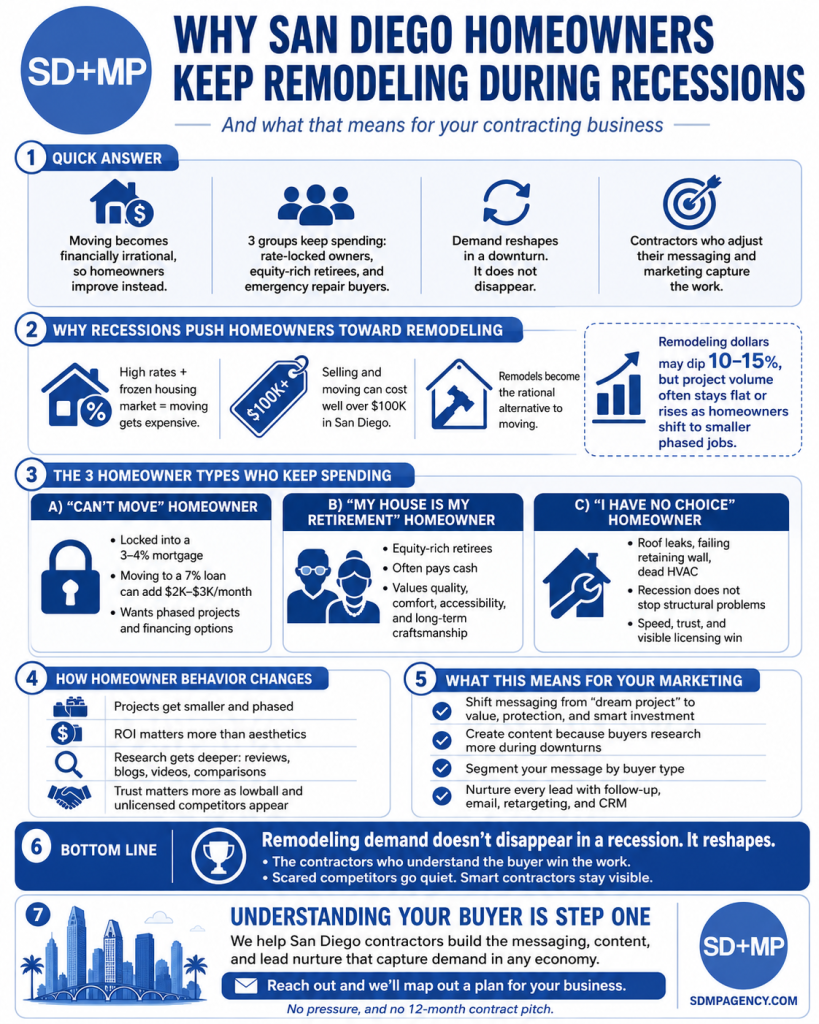
Homeowners remodel during recession because moving becomes financially irrational while staying put creates pressure to improve. Three groups keep spending: rate-locked homeowners who can’t afford to move into a higher mortgage, equity rich retirees whose spending isn’t tied to the job market, and homeowners facing structural emergencies that can’t wait. Demand doesn’t disappear in a downturn, it reshapes. Projects get smaller and more phased, ROI matters more than aesthetics, research deepens, and trust in licensed established contractors becomes more valuable. The contractors who understand this shift and adjust their messaging capture the clients their competitors are too scared to chase.
Why Recessions Push Homeowners Toward Remodeling
Start with the mechanism, because it’s the whole foundation. A recession usually comes with high interest rates and a frozen housing market. Those two things make selling and moving brutally expensive. And when moving is off the table, the only way to fix a home that doesn’t quite work is to remodel it. The recession doesn’t kill remodeling demand. It funnels homeowners straight into it.
That’s why 2020 saw a remodeling surge while the broader economy contracted, and why 2008 hit new construction far harder than improvement spending. The total dollars may dip 10 to 15 percent, but the number of projects often holds flat or even rises as homeowners trade one big splurge for several smaller, smarter jobs. Demand transforms. It doesn’t vanish.
The Three Types of Homeowners Who Keep Spending
Not all buyers behave the same way in a downturn. There are three distinct groups, and each needs a different message from you.
The “Can’t Move” Homeowner
This is the biggest group in San Diego right now, and it’s only getting bigger. These homeowners locked in a 3 to 4 percent mortgage between 2020 and 2022. Moving now means taking on a 7 percent rate, which on a median San Diego home around $950,000 adds something like $2,000 to $3,000 a month to the payment for a comparable house. Then stack on the rest: a Prop 13 reassessment that can raise their annual property taxes by $10,000 or more, realtor commissions of 5 to 6 percent that run $50,000 to $60,000, and the moving costs on top.
The math is punishing, so they stay. And when you stay in a house that doesn’t quite fit your life, you remodel it until it does. These are often dual income professionals who are equity rich on paper but cash-flow constrained in reality. They want the upgrade, but they’re watching every dollar, which means they respond to phased projects and flexible financing far better than to a single six figure proposal.
The “My House Is My Retirement” Homeowner
These are the equity rich retirees, and they’re effectively recession proof. They bought decades ago, owe little or nothing, and sit on cash reserves. A recession doesn’t touch their plan, because their spending isn’t tied to employment income or credit markets. They’re aging in place, and they want the home to be exactly right for the next 20 years.
This buyer pays cash, takes their time, and demands quality over a deal. The wrong move with this segment is to lead with price or urgency. They want legacy craftsmanship, accessibility and comfort features, and a contractor who’ll still be around to stand behind the work. Sell them quality and longevity, not a discount.
The “I Have No Choice” Homeowner
The retaining wall is failing. The roof is leaking into the bedroom. The HVAC died in August. These are the structural imperative buyers, and recessions don’t fix structural failures. This work happens regardless of where the Dow closed today. In San Diego specifically, the canyon terrain and aging housing stock make emergency structural work a constant, reliable demand driver.
This buyer isn’t shopping a dream, they’re solving a crisis, and they’re doing it under stress. Speed, availability, and trust win here. The contractor who answers the phone, shows up fast, and is visibly licensed and reviewed gets the job, often without much price negotiation, because the homeowner just wants the problem solved by someone they can trust.
How Homeowner Behavior Changes (Not Stops, Changes)
Across all three groups, the recession doesn’t stop spending so much as reshape it. Four shifts matter.
- Projects get smaller and phased. The $150,000 full backyard transformation becomes a $30,000 patio and BBQ area, with the rest planned for “next year.” The gut kitchen becomes a cabinet reface and new countertops. Homeowners still spend, they just break big visions into stages. The contractor who offers a smart phase one instead of insisting on the whole project wins the relationship and the future phases.
- ROI obsession kicks in. The question shifts from “will this look amazing?” to “will this add value?” This is where you reframe. Resale recoupment data, like the figures in the annual Cost vs Value report, is useful, but the real argument is the alternative cost. A San Diego homeowner facing $80,000 to $120,000 in transaction costs just to move can put that same money into a remodel that makes the home they’re locked into actually work. Framed against moving, almost any remodel is the rational financial choice.
- Research deepens. In good times a homeowner gets two quotes and picks the one they like. In tough times they get five quotes, read every Google review, watch contractor YouTube channels, and read the blog posts comparing options. The extended research phase is where the contractor with deep, helpful content quietly wins, because they’re the one showing up every time the nervous buyer searches.
- Trust matters more. Downturns flood the market with unlicensed operators chasing work with lowball prices. California’s licensing board issued over 1,600 citations in a single recent year, and you can verify any contractor’s standing right on the CSLB website. Homeowners know the horror stories, and when money is tight, the cost of choosing wrong feels enormous. So they gravitate to licensed, reviewed, established contractors. Your reputation is worth more in a downturn than in a boom.
What This Means for Your Marketing
Understanding the buyer is only useful if you adjust to match. Four moves.
- Speak to the new psychology. Stop selling luxury and start selling value, protection, and smart investment. “Protect your home’s value” and “make the home you can’t leave actually work” beat “create your dream backyard” when wallets tighten. Same services, reframed for a defensive mindset.
- Lean into content. If homeowners research more during recessions, then the contractor with the best blog, the most helpful videos, and the strongest review profile captures them during that long research phase. This isn’t optional in a downturn, it’s the whole game. Our marketing for San Diego contractors page lays out how to build that foundation.
- Segment your message. The cash retiree and the rate-locked young family are not the same buyer and should not get the same ad. One wants legacy quality and craftsmanship. The other needs flexible financing and phased options. Speak to each in their own language instead of blasting one generic “dream home” message at both.
- Nurture every lead. When the sales cycle stretches from two weeks to two months, the “call me when you’re ready” approach loses to the contractor who stays in touch. Email follow up, retargeting, and a CRM that keeps leads warm become essential. The homeowner who wasn’t ready in March closes in May, but only if you’re still in front of them. Our small business marketing page covers the channels that keep you there.
The Bottom Line
Remodeling demand doesn’t disappear during a recession. It reshapes. The total dollar volume might slip 10 to 15 percent, but the number of projects often stays flat or rises as homeowners choose smaller, phased work over one big splurge. The demand is still out there, sitting in three identifiable groups, all with reasons to spend that have nothing to do with the stock market.
The contractors who understand this, and who adjust their messaging, their project mix, and their marketing to match, don’t just survive a downturn. They capture the clients their scared competitors stopped chasing. Knowing your buyer is the edge. Most of your competition is still operating on the assumption that a recession means homeowners stop spending, and they’re wrong.
Frequently Asked Questions
Why do homeowners remodel during a recession instead of moving?
Because moving becomes financially irrational. High rates, a Prop 13 reassessment, realtor commissions, and moving costs can total well over $100,000 on a San Diego home, while remodeling lets a homeowner improve the home they already own at a fraction of that cost. When moving is off the table, improving is the rational alternative.
Does remodeling demand actually drop during a recession?
Total dollars typically dip 10 to 15 percent, but the number of projects often stays flat or rises. Homeowners shift from large single projects to smaller, phased work, so demand reshapes more than it shrinks.
Which homeowners keep spending on remodeling in a downturn?
Three groups: rate-locked homeowners who can’t afford to move, equity rich retirees whose spending isn’t tied to the job market, and homeowners facing structural emergencies like a failing roof or retaining wall that can’t wait for the economy to recover.
How should contractors change their marketing during a recession?
Shift messaging from luxury to value and protection, invest in content since buyers research more, segment messages by buyer type, and nurture leads through a longer sales cycle with email, retargeting, and a CRM. The contractor who stays visible and trustworthy during the research phase wins.
Why does trust matter more during a recession?
Downturns attract unlicensed operators offering lowball prices, and homeowners know the risk of choosing wrong feels higher when money is tight. They seek out licensed, reviewed, established contractors, which makes a strong reputation more valuable during a downturn than during a boom.
Understanding Your Buyer Is Step One
Knowing why homeowners keep spending is the edge. Making sure those homeowners can actually find you is what turns the insight into booked jobs. We help San Diego contractors build the marketing foundation that captures this demand in any economy, with the messaging, content, and lead nurture that match how buyers actually behave when money gets tight.
Reach out here and we’ll map out a plan for your business. No pressure, and no 12 month contract pitch.

