
You’re probably booked out four to six weeks right now. The phone’s ringing, the crews are busy, and the last thing on your mind is a recession. That’s exactly the problem, because right now, while times are good, is the only time you can actually prepare. The contractors who went under in 2008 weren’t bad at their trade. They were just unprepared when the work dried up. Good contractor recession preparation happens during the boom, not after the slowdown hits, and this is the checklist.
If you want the full picture of why remodeling holds up better than you’d think during a downturn, read the companion piece on what happens to San Diego remodelers when the economy crashes. This post is the action plan. Pick a few of these and start this week.
Quick Answer
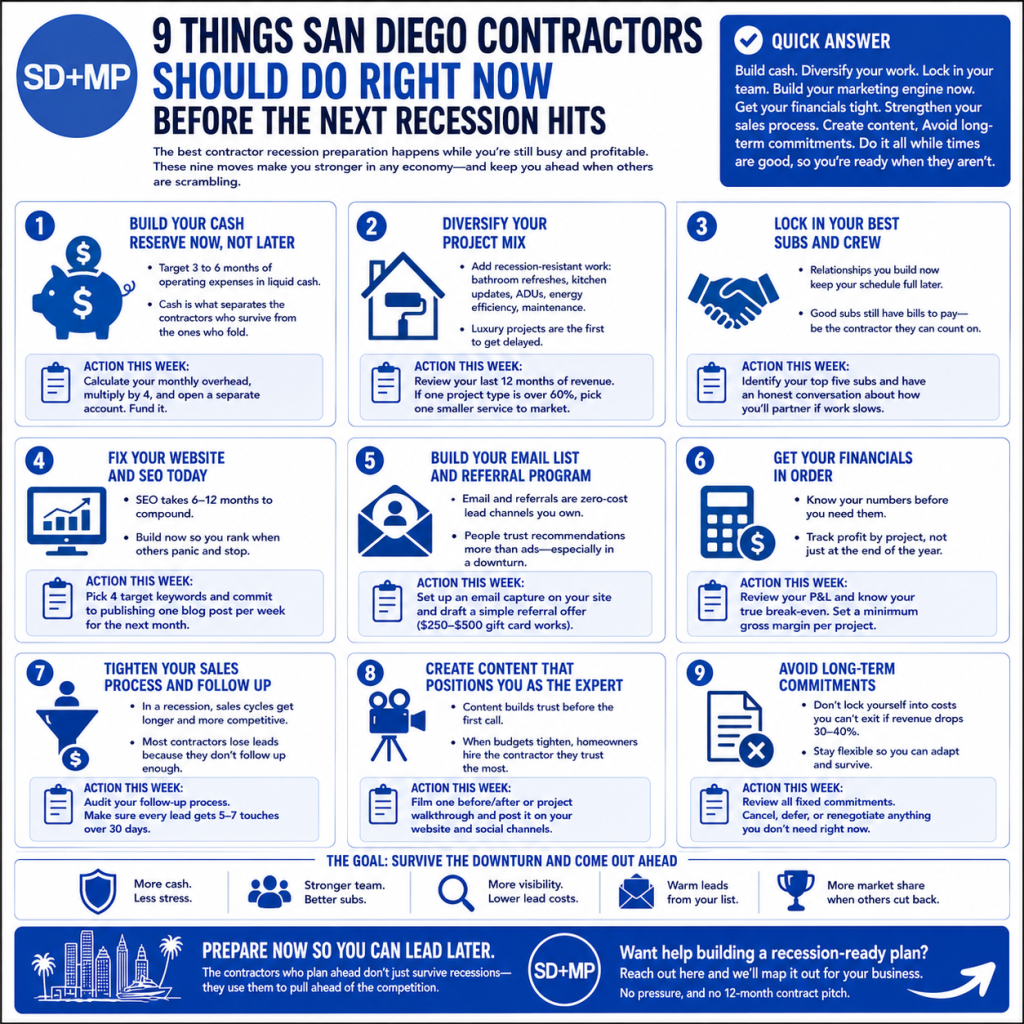
The best contractor recession preparation happens while you’re still busy and profitable. The nine highest impact moves: build a cash reserve of 3 to 6 months of operating expenses, diversify your project mix to add recession resistant work, lock in your best subs and crew, fix your website and SEO now since it takes 6 to 12 months to compound, build an email list and referral program, get your financials in order, tighten your sales process and follow up, create content that positions you as the expert, and avoid long term commitments you can’t exit if revenue drops 30 to 40 percent. None of these require a slowdown to pay off. They make you stronger in any economy.
1. Build Your Cash Reserve Now, Not Later
Cash is what separates the contractors who survive from the ones who fold. The target is 3 to 6 months of operating expenses sitting liquid. If your monthly overhead is $25,000, that’s $75,000 to $150,000 you want in the bank before you need it.
The mistake is waiting until the slowdown to start saving, when there’s nothing coming in to save. So start now, with every profitable job. If you’re running 15 to 20 percent margins, set aside a fixed slice of every deposit and progress payment into a separate account you don’t touch. Treat it like a non negotiable line item, the same as payroll.
Your action this week: calculate your true monthly overhead, multiply by four, and that’s your minimum reserve target. Open a separate account today and route the first deposit into it.
2. Diversify Your Project Mix
If 80 percent of your revenue comes from $100,000-plus luxury outdoor living projects, you’re exposed. Those are the first jobs homeowners shelved when money gets tight. In the last recession, luxury outdoor kitchens fell 58 percent while bathroom refreshes actually gained share.
The fix isn’t to abandon high ticket work. It’s to build a revenue floor underneath it. Add capacity for the smaller, recession resistant jobs: bathroom refreshes at $8,000 to $15,000, kitchen updates at $15,000 to $30,000, ADU conversions that produce income for the homeowner, energy efficiency upgrades, and maintenance work. These keep cash flowing when the big projects pause.
San Diego gives you a specific edge here. Water-wise landscaping rebates run several dollars per square foot through programs like SoCal WaterSmart and county initiatives, which makes drought conversion projects a predictable revenue stream with a built in buyer incentive. That’s a niche that pays whether the economy is booming or not.
Your action this week: look at your last 12 months of revenue and figure out what percentage comes from your top project type. If it’s over 60 percent, pick one smaller service to start marketing.
3. Lock In Your Best Subs and Crew
During a boom, good subcontractors are impossible to book. During a downturn, they’re suddenly available, but they also still need to eat. The contractors who keep relationships warm with their best subs through the slow periods get priority when things pick back up, and they get better rates while everyone else is scrambling.
Your action this week: identify your top five subs. Have an honest conversation with each about what happens if work slows, and float a preferred rate or a loose retainer arrangement. You’re buying loyalty before you need it.
4. Fix Your Website and SEO Today
This is the one with a ticking clock on it. SEO takes 6 to 12 months to compound. If you wait until the recession hits to start building content, you’ll finally rank just in time for the next recovery, having missed the whole downturn. Build it now, while you can afford to be patient.
Concretely: publish two to four blog posts a month targeting the searches your ideal clients actually type, optimize your Google Business Profile, and fix the technical basics like page speed, mobile usability, and meta descriptions. The contractors who dominate organic search during a downturn are the ones who quietly built that foundation during the boom, when their competitors were too busy to bother. We lay out the full approach on our marketing for San Diego contractors page.
Your action this week: pick four keywords your best clients would search and commit to one blog post a week for a month.
5. Build Your Email List and Referral Program
These are your zero cost lead channels when the budget tightens, and they’re assets you actually own. Your Google rankings can shift. Your ad account can get suspended. Your email list is yours no matter what.
Start collecting emails from every lead, including the ones who don’t close, because the homeowner who passed in spring might be ready in fall. Then build a dead simple referral program: offer past clients a $250 to $500 gift card for every referral that turns into a booked job. In a recession this matters even more, because when money is tight, people trust a neighbor’s recommendation far more than they trust an ad.
Your action this week: set up a simple email capture on your site and draft one referral offer you can send to your past client list.
6. Get Your Financials in Order
Know your numbers cold. Not your estimate, your actual job cost. Your real overhead rate. Your break even point. Your minimum viable monthly revenue. Most contractors can quote their gross margin on a good day but couldn’t tell you their monthly fixed costs within $5,000.
That gap is dangerous, because during a downturn the contractors who know exactly where every dollar goes can cut intelligently. The ones who don’t cut blindly, usually slashing the marketing that would have carried them through, and they kill their own recovery. The SBA’s guidance on staying compliant and organized is a decent starting point if your books are a mess.
Your action this week: add up every fixed monthly cost, payroll, rent, vehicles, insurance, software, debt service, and write down the real number. Then calculate the revenue you need just to break even.
7. Tighten Your Sales Process
During a boom you can get away with sloppy follow up, because there’s always another lead behind the one you dropped. During a downturn, every lead matters, and the difference between surviving and not often comes down to close rate.
Audit your process honestly. How fast do you respond to a new inquiry? Do you follow up after sending a proposal, or do you send it and hope? Are you tracking your pipeline anywhere other than your memory? Get a CRM, even a simple one like Zoho, and track every lead, every follow up, and your actual close rate. Here’s the math that should motivate you: when lead volume drops 30 percent, a 10 percent improvement in close rate is the difference between a good year and laying people off.
Your action this week: time your own lead response. If it’s longer than an hour, that’s the first thing to fix.
8. Create Content That Positions You as the Expert
During recessions, homeowners research more before they spend. They read every review, watch the videos, and compare contractors obsessively, because the stakes of choosing wrong feel higher when money is tight. The contractor with 20 blog posts, a deep portfolio, and 50 five star reviews wins the job over the guy with a one page site and a phone number, every time.
The catch is that you build this while you have active projects to document. You can’t manufacture a portfolio during a slow stretch when nothing’s getting built. So photograph and film your current jobs now: before and after sets, project walkthroughs, quick how to clips. Bank that content while the work is flowing. Our small business marketing page covers how to turn it into a steady presence.
Your action this week: assign someone on every active job to capture before, during, and after photos, starting with the next job that breaks ground.
9. Don’t Sign Long Term Commitments You Can’t Exit
A boom makes everything feel affordable. New shop space, financed equipment, a new truck, another full time hire. The trap is locking into fixed liabilities right before revenue could drop.
Run a simple stress test on any commitment that requires 18 or more months of payments: could you still cover it if your revenue fell 30 to 40 percent? If the answer is no, find a more flexible arrangement, rent instead of buy, lease shorter, or subcontract instead of hiring full time. This isn’t about freezing up and investing in nothing. It’s about the difference between assets and liabilities. Invest freely in things that pay off in any economy, your website, your content, your skills, and be cautious with anything that becomes a fixed monthly payment hanging over your head.
Your action this week: list every fixed commitment over 18 months and stress test each one against a 35 percent revenue drop.
Where to Start
You don’t have to do all nine at once. That’s a recipe for doing none of them. Pick the three your business needs most and start this week. If your cash reserve is thin, start there. If your website is a one page brochure, start there. If you couldn’t tell me your monthly overhead, start there.
If figuring out where your next marketing dollar should go is part of the puzzle, we cover that in detail in our breakdown of where San Diego contractors should advertise.
Frequently Asked Questions
How should contractors prepare for a recession?
The highest impact moves are building a cash reserve of 3 to 6 months of operating expenses, diversifying into smaller recession resistant projects, locking in your best subs, building your website and SEO before you need it, growing an owned email list and referral program, knowing your real financials, tightening your sales follow up, banking expert content while jobs are active, and avoiding long term commitments you can’t exit.
How much cash reserve does a contractor need?
Aim for 3 to 6 months of operating expenses held liquid. If your monthly overhead is $25,000, that’s a target of $75,000 to $150,000. Start funding it now from profitable jobs rather than waiting for a slowdown.
Why should contractors build SEO before a recession instead of during one?
Because SEO takes 6 to 12 months to compound. If you start when the slowdown hits, you’ll only begin ranking around the time the recovery arrives, missing the entire downturn. Building during the boom means you dominate organic search exactly when competitors go quiet.
What kinds of projects are most recession resistant for contractors?
Smaller, practical jobs hold up best: bathroom refreshes, kitchen updates, ADU conversions, energy efficiency upgrades, maintenance work, and in San Diego, rebate backed water-wise landscaping conversions. These build a revenue floor under your higher ticket work.
Is it smart to cut marketing during a downturn?
No. Contractors who maintain marketing during a downturn gain market share as competitors pull back, and ad costs typically drop. The smart move is to cut waste, not visibility, and to lean harder on owned channels like email, referrals, and content.
Pick Three and Start This Week
Preparation beats prediction. Nobody knows exactly when the next slowdown comes, but the contractors who get ready while they’re busy are the ones who come out the other side bigger, with cheaper leads and fewer competitors. The work you do now is what decides that.
If building your website and marketing foundation is one of your three, that’s exactly what we do for San Diego contractors. Reach out here and we’ll help you get it in place before you need it. No pressure, and no 12 month contract pitch.

