
You do beautiful work. Your reviews prove it, your past clients rave about you, and your portfolio could hang in a design magazine. So why does the phone only ring when a past client tells a neighbor about you? If you’ve tried boosting a few posts, running some ads, or paying for a cheap website and nothing seemed to connect, this is the remodeler marketing playbook that explains why, and what the remodelers winning the biggest projects in San Diego are doing differently.
The Piecemeal Problem
Here’s the pattern I see constantly with remodelers in this market. The business is good. The work is good. So the owner decides it’s time to do some marketing.
They hire a freelancer to post on Instagram. The freelancer has no photos to work with, so the feed fills up with stock images and quote graphics. Then they hire an ads guy who runs Google Ads pointing at a website built on Wix three years ago by a nephew. The site loads slow, the project photos are phone shots in bad light, and the contact form is buried. Then maybe an SEO company calls promising page one rankings, charges $800 a month, and sends a confusing report nobody reads.
Three vendors, three invoices, zero results. And the worst part is none of it was crazy. Each piece can work. The problem is that none of the pieces talk to each other, so nothing connects and nothing compounds. The ads dump traffic onto a site that doesn’t convert. The social account has nothing real to post. The SEO company builds pages with no photos worth showing. The remodeler concludes that marketing doesn’t work, cancels everything, and goes back to praying for referrals.
Marketing for remodelers works fine. Piecemeal marketing doesn’t.
What Full Stack Remodeler Marketing Actually Means
Full stack marketing is one team handling the entire system: the content, the website, the SEO, the ads, and the social posting. Not five vendors. One.
The reason this matters isn’t convenience, although having one point of contact and one monthly number instead of juggling three vendors is a real relief. The reason it matters is that every layer of marketing feeds the others, and that only happens when the same team runs all of them.
The crew shooting your job sites feeds the social calendar. That same footage becomes your ad creative. Your website showcases that work and converts the traffic the ads and search rankings bring in. The SEO strategy decides which projects get shot and which pages get built. It’s one machine, and when one team runs the whole thing, every dollar you spend in one place makes the other places work better.
Let me walk through each layer and what it actually does for a remodeling company.
The Content Layer: The Engine
This is where almost every remodeler marketing effort dies, so I’ll be blunt. Stock photos and generic posts do not convert in this industry. A homeowner about to spend $80,000 to $200,000 on a remodel does not care about a stock photo of a kitchen in Ohio or a graphic that says “Quality You Can Trust.” They want to see your work, your job sites, your clients saying your name on camera.
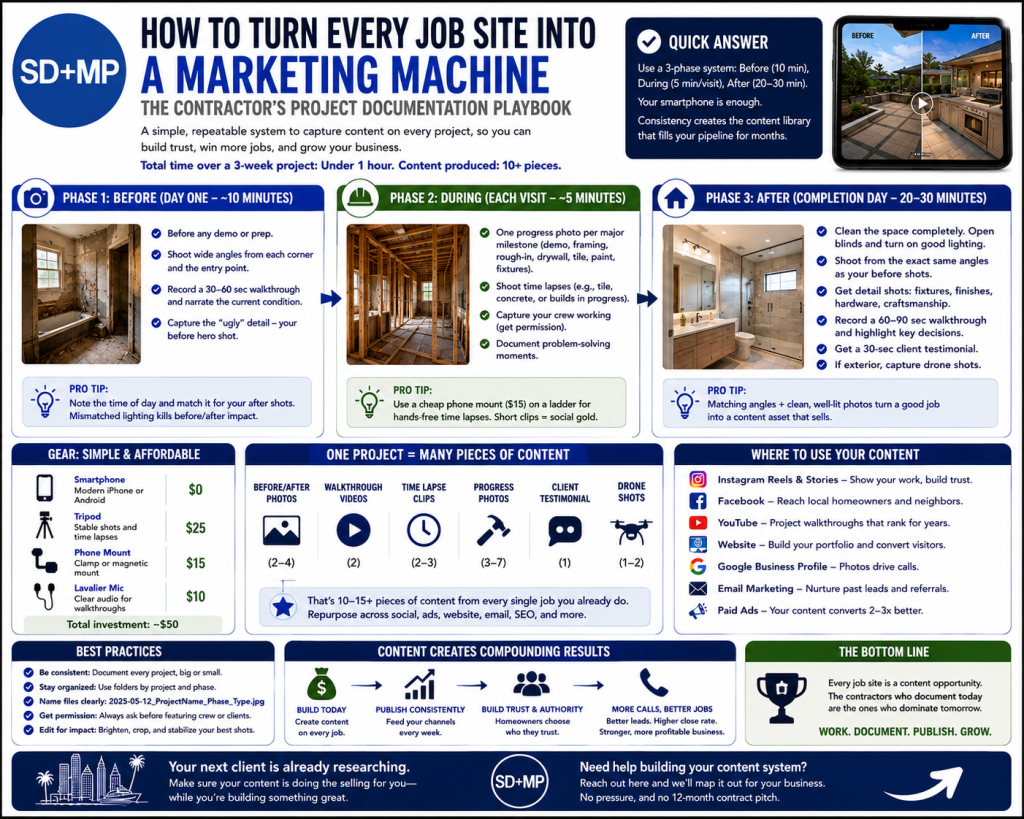
Original job site content is the engine of the entire system. That means professional photos of finished projects, shot in good light by someone who knows how to shoot interiors. Before and after sets, because nothing sells a remodel like the transformation. Walkthrough videos where the homeowner can actually feel the space. Reels showing the process, the demo day, the crew, the reveal. And testimonial videos, which are the single most persuasive asset a remodeler can own, because a real client telling their story does what no ad copy ever will.
Here’s why this is the foundation and not an add-on: every other layer runs on this material. Without it, your social feed is empty, your ads are generic, and your website looks like everyone else’s. With it, everything else gets easier and cheaper. Most agencies in this space only do SEO and ads, then ask you to supply the photos and video. That’s backwards, and it’s why their clients churn.
The Web and SEO Layer: The Hub
Your website is where every lead ends up before they contact you, whether they found you through an ad, a Google search, Instagram, or a neighbor’s recommendation. They all check the website before they call. If the site is slow, dated, or thin, you’re losing jobs you never knew you were in the running for.
A remodeler’s site needs to do three things. Rank, load, and convert.
Ranking means showing up for searches like “kitchen remodel San Diego” and “bathroom remodeler near me,” and that takes real structure: a dedicated page for each service, local schema markup so Google understands exactly what you do and where, and pages targeting the neighborhoods you actually want to work in. San Diego is a sprawl of distinct markets, and a remodeler ranking for La Jolla, Encinitas, and Poway searches individually pulls leads a single generic page never sees. Your Google Business Profile is part of this layer too: categories set correctly, photos uploaded consistently, reviews coming in and getting responses.
Loading means fast. Homeowners browse contractor sites on their phones at night, and a site that takes six seconds to load is a back button.
Converting means the site makes it stupid easy to take the next step. Clear calls to action, a simple form, a phone number that’s tappable, and project galleries deep enough that a serious prospect can binge your work. This is where the content layer pays off again: a portfolio full of professional photography converts at a completely different rate than a grid of phone shots.
The Ads Layer: The Accelerator
Once the foundation exists, ads are how you stop waiting and start choosing your lead volume.
Google Ads captures people actively searching for a remodeler right now. These are the highest intent leads in existence, and in San Diego they’re priced like it. Clicks for remodeling keywords are competitive, which is exactly why the ad can’t dump people onto a weak page. A Google ad pointing to a landing page with real project photos, a real testimonial video, and a clear form converts at a multiple of the same ad pointing to a generic homepage. Same ad spend, very different cost per lead.
Meta Ads play a different role. Almost nobody wakes up and impulse buys a kitchen remodel. Homeowners plan these projects for months, and Meta is how you stay in front of them during that window. Retargeting people who visited your site, showing your best reveals and walkthroughs to homeowners in your service area, building the familiarity that makes them shortlist you when they’re finally ready. Meta ads built from real job site video consistently outperform anything built from stock assets, because the content layer strikes again.
The Social Layer: The Trust Builder
Let me kill a myth: in remodeler marketing, social media is not about going viral. A reel with 400 views is a win if 50 of those views are homeowners in your service area watching your crew transform a kitchen.
The actual goal is repetition. A homeowner typically needs to see your work several times before your name feels familiar enough to call. Consistent posting of real projects, real process, and real clients builds that familiarity on autopilot. It also does quiet work you never see: when a referral hears your name at a dinner party, the first thing they do is look you up on Instagram. An active feed full of beautiful finished work closes that referral before you ever speak to them. A dead feed with a stock photo plants doubt.
Consistency beats cleverness here, and consistency is only possible when someone is producing a steady stream of real content. Which, again, is why the content layer is the engine.
How It All Connects: One Shoot, Five Assets
Here’s the part that makes the full stack model click, and it’s the thing piecemeal vendors can never give you.
We shoot one finished kitchen remodel. Half a day on site. From that single shoot comes a vertical reel for Instagram and the same cut for Meta ads. A before and after post that becomes the best performing organic content remodelers have. A set of edited photos that updates the portfolio page and strengthens the SEO on the kitchen remodeling page. A hero image for the Google Ads landing page, so paid traffic lands on proof instead of promises. And if the client is willing, a testimonial video that works on the website, in ads, and in your sales conversations for years.
One shoot, five assets, every layer of the system fed at once. Do that every month and the system compounds: the portfolio deepens, the rankings climb, the ads convert better, the feed stays alive, and every new lead arrives pre-sold by months of visible proof. That compounding is the entire difference between remodeler marketing that builds an asset and marketing that burns a budget.
This is the model we run at SDMP for remodelers and design-build firms across San Diego. You can see the full breakdown of services on our marketing for San Diego contractors page, and if you’re trying to figure out what this should cost at your revenue level, read our guide to contractor marketing budgets in 2026 first.
See What This Looks Like for Your Business
If you’re a remodeler with great work and a phone that only rings from referrals, the problem was never your work. It’s that nobody can see it. The fix for San Diego remodeler marketing is a connected system, not another disconnected vendor.
Reach out here and we’ll look at your current setup, show you exactly where the gaps are, and walk you through what a full stack plan looks like for your company. Real numbers, no pressure, and no 12 month contract pitch.

