
You have a website. It looks fine. It shows your work, lists your services, has your phone number. So why does almost nobody who lands on it ever call? If your site gets traffic but the phone stays quiet, the problem usually isn’t traffic. It’s that your website was built to be looked at, not to convert. That’s where we step in and help with Contractor Website Leads.
Quick Answer
Most contractor websites don’t generate leads because they’re built like brochures instead of lead generators. Industry data shows the average home services website converts only 2 to 3 percent of visitors into leads, meaning 97 to 98 percent leave without ever making contact. The most common reasons are slow mobile load times, no clear call to action, generic copy that doesn’t address the homeowner’s actual problem, missing trust signals, and forms that ask for too much. The fix is to treat your website as a salesperson with one job: turning a visitor into a phone call or form fill.
Why Isn’t My Contractor Website Generating Leads?
Here’s the hard truth. A website can look professional, work on a phone, and even rank decently in search, and still produce almost no leads. Looks and conversion are two different things, and most contractor sites are optimized for the wrong one.
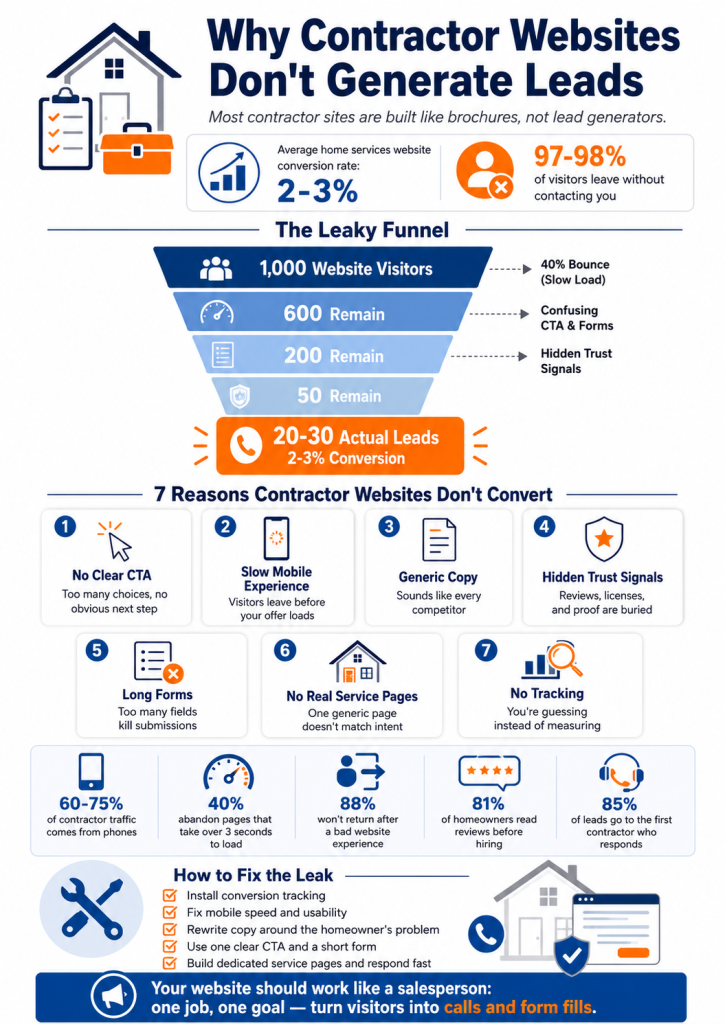
The average contractor website converts 2 to 3 percent of its visitors. That means if 1,000 people visit your site this month, you might get 20 to 30 inquiries, and that’s if everything is working. If your site has the common problems below, that number drops fast. You’re not losing leads because people don’t want your service. You’re losing them in the gap between “visitor arrives” and “visitor contacts you.”
THE CONTRACTOR WEBSITE LEAKY FUNNEL

[ 1,000 Website Visitors ]
            ↓
[ 40% Bounce (Slow Load) ] ➔ 600 Remain
            ↓
[ Confusing CTA & Forms  ] ➔ 200 Remain
            ↓
[ Hidden Trust Signals   ] ➔ 50 Remain
            ↓
[ 20-30 Actual Leads ] (2-3% Conversion)
It gets worse on a first impression. Studies show 88 percent of visitors won’t return after a bad website experience, and around 40 percent abandon a page that takes more than three seconds to load. You usually get one shot, it happens on a phone, and it happens in about three seconds.
The 7 Reasons Contractor Websites Don’t Convert
Most underperforming sites aren’t broken in one way. They’re leaking in several places at once. Here are the seven that matter most.
1. No Clear, Single Call to Action
A lot of contractor sites bury the phone number in the header and hope people find it. Others do the opposite and pile on every option at once: call us, email us, fill the form, chat, follow us, download the brochure. When a visitor faces six choices, the common response is to pick none of them.
Good sites pick one primary action per page and repeat it. A tappable “Call Now” button on mobile. A “Get a Free Estimate” form above the fold on desktop. Same action, same color, repeated top, middle, and bottom. Everything else is visually secondary.
2. Slow Load and a Clumsy Mobile Experience
Between 60 and 75 percent of contractor website traffic comes from a phone. A homeowner is standing in the kitchen looking at a water stain, or sitting in the driveway after spotting a roof problem, and they’re searching on the spot. If your site is slow, has tiny buttons, or makes them pinch and zoom, a big chunk of them are gone before they ever see your offer.
Speed isn’t only a conversion problem either. A slow site ranks lower in search and costs more per click on ads, so it loses you traffic on both ends while it’s failing to convert the traffic it does get.
3. Generic Copy That Could Belong to Anyone
“Quality workmanship.” “Customer satisfaction guaranteed.” “Licensed and insured.” “Serving the community for over 20 years.” None of that is false, and none of it makes a homeowner choose you. It’s the same language every competitor uses.
A homeowner searching for an emergency plumber at 11 PM does not care about your 20 year history. They care whether someone will actually show up tonight, what it might cost, and whether they can trust you in their home. Copy that speaks to the visitor’s situation right now beats copy about your company every time. The formula that works: name the problem, state the solution, give the next step. “Roof leaking? Get a free inspection within 24 hours” does more than any tagline.
4. Trust Signals Hidden Where Nobody Looks
Trust is the whole game in home services. You’re asking a stranger to let you into their house and hand over a lot of money for work they can’t easily judge. Yet most contractor sites park their reviews, licenses, and badges on an About page that almost nobody clicks.
Put the proof where the decision happens. A review snippet next to the contact form. A “Licensed and Insured” badge near the phone number. Before and after photos next to the service description. Around 81 percent of homeowners read reviews before hiring, so your star rating and review count belong above the fold, not three clicks deep.
5. Forms That Ask for Too Much, Too Soon
A form that wants name, email, phone, address, project description, budget, timeline, and how they heard about you is a wall. Every extra field drops your completion rate, and on a phone, people just quit.
Cut the first form to the essentials. Name, phone, and a service type dropdown is usually enough. You can qualify the rest on the call. Some contractors do even better with a simple “request a callback” that asks for nothing but a phone number and the best time to reach them.
6. One Generic Services Page Instead of Real Service Pages
A single page that lists everything you do in two sentences each hurts you twice. It limits your SEO, because search engines reward pages that fully cover one topic over pages that mention many. And it fails the visitor, because someone searching “emergency roof leak repair” who lands on a catch-all services page has to work to confirm you even handle that, and a lot of them bounce to a competitor whose page speaks to their exact problem.
Build a dedicated page for each major service, especially the high intent ones people search for by name.
7. No Tracking, So You’re Guessing
This is the quiet one. Without call tracking, form analytics, and conversion tracking tied to each traffic source, you have no idea whether your problem is too little traffic, the wrong traffic, or a site that doesn’t convert. So contractors pour money into more ads or more SEO when the actual leak is on the page itself. You can’t fix what you aren’t measuring.
How Do I Get My Contractor Website to Generate More Leads?
The order matters here. Don’t start with a redesign. Start by finding the leak.
- First, install tracking. Set up conversion tracking in Google Analytics for form fills and click-to-call, and use a tracking phone number so you know which channel produces actual calls.
- Second, fix mobile. Open your own site on your phone right now. Time the load. Try to call in one tap. Try to fill the form.
- Third, rewrite for the visitor. Lead with their problem and the next step, not your company history.
- Fourth, simplify. One clear action per page. A short form. Trust signals next to every place you ask someone to contact you.
- Fifth, build out your service pages and keep the site fed. Dedicated pages for each service, location pages for the San Diego neighborhoods, and fresh photos added regularly.
There’s one more piece that lives off the website but kills more deals than any of these: speed to lead. A perfect website that captures a lead you don’t call back for six hours is still a lost lead.
This is exactly why a connected approach beats a pile of disconnected vendors. The website, the content that fills it, and the follow up all have to work as one system. We break down that full model in our San Diego remodeler marketing playbook, and you can see how we handle the whole stack on our marketing for San Diego contractors page.
The Mindset Shift
Here’s the whole thing in one line. Stop thinking of your website as a digital brochure and start thinking of it as a salesperson who works 24 hours a day and has one job: getting the visitor to make contact.
Frequently Asked Questions
Why is my contractor website not getting any leads?
Usually because it’s built to inform instead of convert. The average contractor site converts only 2 to 3 percent of visitors, and common mistakes push that even lower.
What is a good conversion rate for a contractor website?
The industry average for home services is around 2 to 3 percent of visitors becoming leads.
How fast should I respond to a website lead?
As close to five minutes as possible. Most lead response studies cite 30‑50% first‑responder advantage.
Do I need a new website to get more leads?
Not always. Start by tracking your conversions to find the real leak. Many contractors fix lead flow with copy, call to action, mobile, and form changes on their existing site.
See Where Your Site Is Leaking
If your website gets visitors but not calls, the leak is findable and usually fixable. We’ll audit your current site against every failure point above, show you exactly where you’re losing leads, and walk you through what it takes to turn the traffic you already have into real inquiries.
Reach out here and we’ll take a look. Real feedback, no pressure, and no 12 month contract pitch.

