
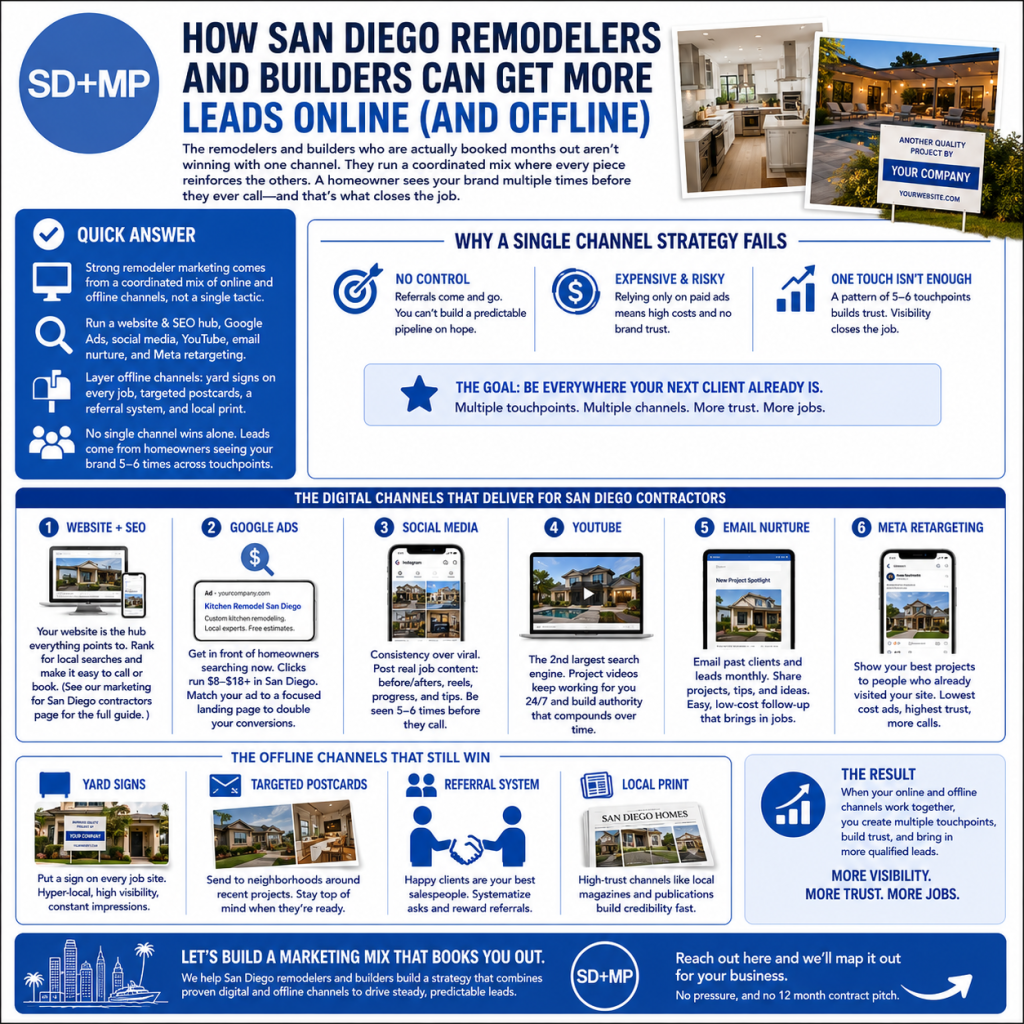
Most marketing agencies only want to talk about digital. But the remodelers and builders who are actually booked six months out aren’t winning because they nailed one channel. They’re running a mix where every piece reinforces the others. A homeowner sees your yard sign, looks you up on Instagram, lands on your website, then pulls your postcard out of the mailbox a week later. That layered visibility is what closes the job, and getting your remodeler marketing San Diego strategy right means building that mix on purpose.
Quick Answer
Strong remodeler marketing San Diego comes from a coordinated mix of online and offline channels, not a single tactic. The builders booking out months in advance run a website and SEO hub, Google Ads for immediate leads, consistent social posting, YouTube, email nurture, and Meta retargeting, then layer offline channels on top: yard signs on every job, targeted postcards around finished projects, a systematized referral program, and high trust local print. No single channel wins alone. The leads come from a homeowner seeing the same brand five or six times across different touchpoints before they ever call.
Why a Single Channel Strategy Fails
Let’s be direct. Leaning on one lead source is how you get a great first quarter and a dead third quarter. The guy living on referrals has no control over his pipeline. The guy running only Google Ads is paying $40 a click to strangers who have never heard of him and don’t trust him yet. The contractors who grow steadily, from La Jolla to Chula Vista, are the ones running three, four, five channels at once.
Here’s the principle underneath all of it. One touchpoint is almost never enough to win a remodel. A homeowner spending $60,000 to $100,000 needs to see your brand several times before they feel safe picking up the phone. A yard sign by itself is a glance. A yard sign, plus an Instagram feed full of your work, plus a postcard the following week, that’s a pattern. And a pattern reads as trust. So the real goal isn’t to perfect one channel. It’s to be everywhere your next client already is.
The Digital Channels That Deliver for San Diego Contractors
Start with the online side. This is what most agencies focus on, and for good reason: it’s measurable and it scales. But it works best wired to your offline efforts, not run in a vacuum.
Your Website and SEO: The Hub
Your website is the hub everything points back to. The yard sign, the business card, the postcard, the social bio, all of it should funnel people here. So it can’t be a generic template. It needs to rank for the searches homeowners actually type, like “kitchen remodel San Diego” or “bathroom renovation Encinitas,” and when they land, they need to see real project photos, a phone number they can tap, and a form that takes ten seconds.
For the full breakdown of how to structure that, see our page on marketing for San Diego contractors.
Google Ads for Leads Right Now
SEO takes months. Google Ads works today. Someone searching “patio builder San Diego” has a problem and wants it solved now, so if you’re at the top of the results, you get the call. Clicks for premium remodeling keywords in this market run roughly $8 to $18, and the cost per lead climbs from there, so you can’t afford to waste the click.
The mistake nearly everyone makes is sending that expensive traffic to their homepage. If the ad is about kitchen remodels, the click needs to land on a kitchen remodel page, stripped of distractions and built to do one thing: book a consultation. Matching the landing page to the ad can double your conversion rate off the same spend. Google’s own Google Ads help center walks through the setup if you’re running it yourself.
Social Media: Consistency Over Going Viral
Social media for a remodeler is not about chasing a viral hit. It’s about being seen. A homeowner in Rancho Santa Fe should see your work five or six times before they call, and consistent posting is how that happens quietly in the background.
Post real job site content. Before and after photos, short reels, project walkthroughs. Show the demo, the mess, the process, and the reveal. It’s not about polish, it’s about proof that you’re real, you’re local, and you do good work. We dig into the visual side of this in our guide to why before and after photos win more jobs, and you can see how we approach it on our small business marketing page.
YouTube for Authority That Compounds
YouTube is the second largest search engine in the world, and most contractors completely ignore it. That’s a gift if you don’t.
Film a simple walkthrough of a backyard remodel in Del Mar. Walk the space, explain what you changed and why, and upload it with a clear title like “Del Mar Backyard Remodel Before and After.” Unlike an Instagram post that vanishes from the feed in a day, that video keeps pulling views and leads for years. A library of project videos builds authority that compounds the whole time you’re sleeping.
Email Nurture: The List You’re Ignoring
You already have a list of past clients and a list of people who asked for an estimate and didn’t book. That list is gold, and most contractors never touch it.
Send one email a month. Recent projects, a seasonal maintenance tip, a design trend. The homeowner who got a quote from you four months ago may have stalled on timing, not on you, and they might be ready now. A simple monthly email puts you back in front of them with zero pressure. Contractors lose tens of thousands a year just by failing to follow up.
Retargeting Ads on Meta
Retargeting is the cheapest ad spend you’ll ever run. Someone visits your website and doesn’t call, so for the next 30 days you show them your single best before and after project on Facebook and Instagram. They already know who you are, so you’re just staying in view while they decide. It converts at a high rate precisely because it’s warm traffic, not cold.
The Offline Channels Most Agencies Ignore
Here’s where the agencies that only do digital go quiet, and where successful contractors separate from the pack. Offline marketing isn’t dead. For a local remodeler, it’s some of the highest trust, lowest cost lead generation available, because it catches homeowners in their actual daily routine.
Yard Signs on Every Active Job
Yard signs are the most underrated lead tool in contracting, and the math is almost unfair. A durable sign costs a few dollars. A single Google ad click can cost $40 or more. So you stake a branded sign at the street on day one of every project and let it work for the whole job.
Your neighbors are already watching. They see your trucks show up on time, they notice your crew keeps the site clean, and they’re forming an opinion before the drywall’s even up. The folks on that street are your next clients, especially in tight neighborhoods like La Jolla or Del Mar where everyone notices a remodel. The sign just makes it dead simple for them to find you.
Targeted Postcards and EDDM
Direct mail is still one of the most effective ways to reach affluent homeowners, and Every Door Direct Mail lets you hit specific carrier routes without buying an expensive list. You can read the basics on the USPS EDDM page.
The play is to target the streets around your finished projects. You just wrapped an $80,000 backyard remodel in Encinitas? Send 500 oversized postcards to that zip code showing the before and after. Those neighbors have been watching the work happen for weeks, so the postcard connects your brand to the project they already noticed. At roughly $0.45 to $0.65 a piece, that’s a fraction of a single search click, aimed at the exact people most likely to want the same thing.
High Trust Print
High volume digital gets all the attention, but high net worth homeowners still read local print. A neighborhood newsletter, an HOA publication, or a premium local magazine puts you in front of an exclusive audience. This isn’t a volume play, it’s a trust play. A half page ad in the Rancho Santa Fe Review hits exactly the homeowner planning a major custom build, and it embeds your name into the fabric of that community.
How the Channels Compare
| Channel | Typical Cost | Lead Intent | Trust |
|---|---|---|---|
| Google Search Ads | $100 to $350 per lead | Very high | Low at first |
| Organic Website Traffic | $40 to $120 per lead | High | High |
| Targeted Postcards | $0.45 to $0.65 per piece | Medium | High neighborhood trust |
| Yard Signs | $5 to $15 per sign | Medium | Maximum local authority |
The point of the table isn’t to pick a winner. It’s to show that these channels do different jobs at different costs, which is exactly why you run them together.
How the Mix Works Together
Theory is fine, but watch how this plays out on one real project.
You finish a patio and outdoor kitchen remodel in La Jolla. On the first day of demo, your crew stakes a yard sign at the street. As the job wraps, you mail 500 postcards to that zip code. Your team posts a before and after reel on Instagram. You publish a project spotlight on your blog for SEO. You upload a narrated walkthrough to YouTube. You email a photo of the finished space to your entire past client list. That one project just touched six channels.
Now follow a neighbor. Tuesday, she walks her dog past your yard sign. Wednesday, she Googles you, lands on your site, and a tracking pixel quietly tags her. Thursday, that exact patio shows up in her Instagram feed as a retargeting ad. The next week, your postcard is in her mailbox showing the same transformation. By the time she calls, you’re not a random contractor she found online. You’re the established name that’s been all over her neighborhood. That’s how you book the next premium job without burning $40 a click on cold search traffic.
This is also why your visual content has to be locked down before any of it runs. Every one of those six touchpoints used the same project photos and video, so the better your job site capture, the more mileage every channel gets. Your Google listing is part of this too, since photo volume there drives calls directly, which we cover in our Google Business Profile photo guide.
Setting Up a Systematized Referral Program
Referrals are gold, but hoping a happy client remembers your name on their own is a wish, not a strategy. The contractors who build an actual system around referrals pull 30 to 40 percent of their leads this way. Most contractors never even ask.
Here’s the system. First, build a dedicated referral page on your website that spells out exactly how it works. Second, offer a real incentive. The standard that works is a $200 Visa gift card or $250 off future work for any referral that turns into a booked project. Third, and this is the part that makes it run on its own, automate a follow up email to every client right after the final walkthrough, when their satisfaction is at its peak. Include the link to the referral page and the incentive, make it stupid easy to forward, and make it worth their time.
Do that and your past client list stops being a static spreadsheet and becomes an active sales force that feeds you leads month after month.
Frequently Asked Questions
What is the best way for a San Diego remodeler to get more leads?
Run a coordinated mix rather than one channel. Combine a website and SEO hub, Google Ads, consistent social posting, YouTube, email nurture, and retargeting with offline channels like yard signs, targeted postcards, print, and a referral program. The leads come from a homeowner seeing your brand repeatedly across these touchpoints.
Do offline marketing channels still work for contractors?
Yes. For a local remodeler, yard signs, EDDM postcards, and local print are among the cheapest, highest trust lead sources available. A yard sign costs a few dollars against $40 or more for a single search click, and postcards around a finished project reach the exact neighbors already watching the work.
How much of a remodeler’s leads should come from referrals?
Contractors who systematize referrals typically get 30 to 40 percent of their leads from them. The system is a referral page on your site, a clear incentive like a $200 gift card, and an automated follow up email sent right after the final walkthrough.
Why shouldn’t I send Google Ads traffic to my homepage?
Because the homepage isn’t built to convert a specific search. If someone clicks an ad for a kitchen remodel, send them to a kitchen remodel landing page focused on booking a consultation. Matching the page to the ad can double your conversion rate on the same spend.
How do online and offline channels work together?
They reinforce each other. A single finished project can feed a yard sign, postcards, an Instagram reel, a blog spotlight, a YouTube walkthrough, and an email blast. A neighbor who sees several of these touchpoints comes to view you as the established local authority, which removes the risk they feel about hiring.
Ready to Build a Marketing Mix That Fills Your Pipeline?
The days of running a remodeling business on one lead source are over. The builders stuck on the revenue rollercoaster are the ones still betting everything on a single channel. The ones booking out months in advance are running the full mix, online and offline, with every touchpoint pointing back to the same brand.
We help San Diego contractors put all of these pieces together, the digital infrastructure and the physical outreach, not just one slice of it. Reach out here and we’ll map out a plan for your business. No pressure, and no 12 month contract pitch.

