
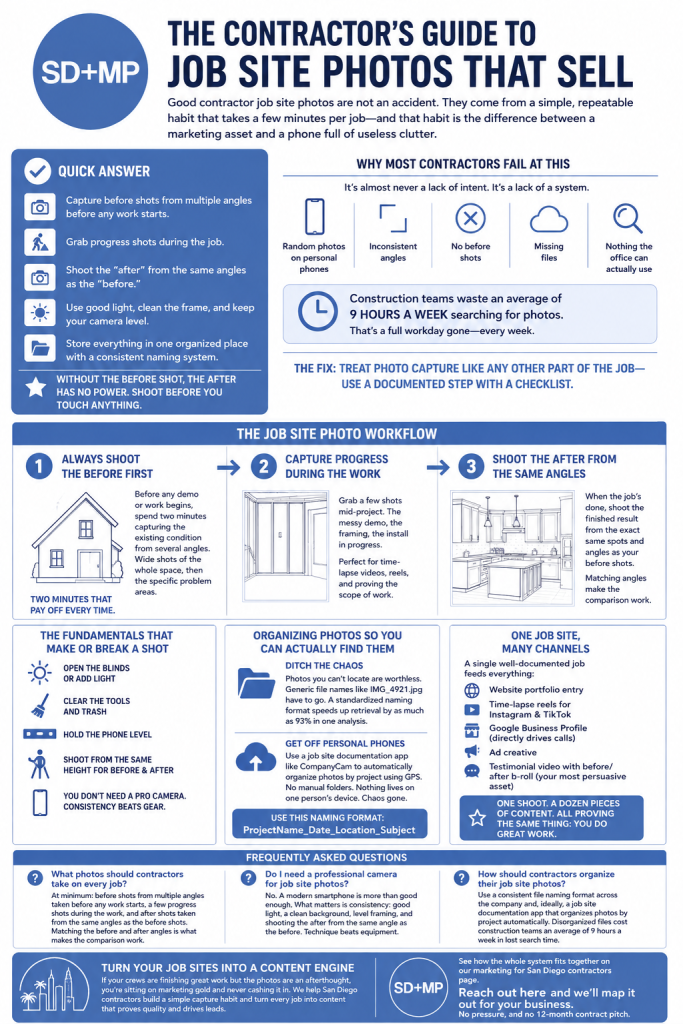
Every contractor knows they should be taking more photos. Almost none of them have a system for it, so the photos that do get taken are blurry, badly lit, missing the “before,” and scattered across three crew members’ phones where nobody can find them. Good contractor job site photos are not an accident. They come from a simple, repeatable habit that takes a few minutes per job, and that habit is the difference between a marketing asset and a phone full of useless clutter.
Quick Answer
The key to useful contractor job site photos is a standard routine, not better equipment. Capture before shots from multiple angles before any work starts, grab progress shots during the job, and shoot the “after” from the same angles as the “before.” Use good light, clean the frame, and store everything in one organized place with a consistent naming system. Without the before shot, the after has no power, so the most important rule is to shoot before you touch anything. A two-minute habit at the start of every job feeds your website, your social, your ads, and your Google listing for months.
Why Most Contractors Fail at This
The reason contractors miss out on visual marketing is almost never a lack of intent. It’s a lack of a system. When you rely on whoever’s on site to snap a few random photos on a personal phone, you get chaos: inconsistent angles, no before shots, missing files, and nothing the office can actually use. Construction teams waste an average of 9 hours a week digging through disorganized files looking for specific photos. That’s a full workday gone, every week, to disorganization.
The fix is to treat photo capture like any other part of the job: a documented step with a checklist. Here’s the workflow.
The Job Site Photo Workflow
Step 1: Always Shoot the Before First
This is the one that hurts most when you forget it. Without the before shot, the after loses all its power, because the comparison is what creates the payoff. So build it into your job startup. Before any demo or work begins, spend two minutes capturing the existing condition from several angles. Wide shots of the whole space, then the specific problem areas. This two-minute habit pays off across every channel you’ll ever post to.
And it’s not just about taking contractor job site photos for marketing. It’s also about “CYA” for situations where the homeowner has a different perspective on what the site looked like “before” and also to cover previous damage your crew had nothing to do with. Just like when you rent a car, you take photos before, every project needs to do the same for liability.
Step 2: Capture Progress During the Work
Grab a few shots mid-project. The messy demo, the framing, the install in progress. These become the “rising action” in your story and they’re gold for time-lapse videos and process reels. They also prove the scope of the work, which helps justify your price later.
Step 3: Shoot the After From the Same Angles
When the job’s done, shoot the finished result from the exact same spots and angles as your before shots. Matching angles is what makes a clean side-by-side or a slider work. Mismatched angles break the effect and the brain stops reading it as a true comparison.
The Fundamentals That Make or Break a Shot
Inconsistent angles, poor lighting, and cluttered backgrounds destroy the impact of a transformation. So before you shoot: open the blinds or add light, clear the tools and trash out of frame, hold the phone level, and shoot from the same height for before and after. You don’t need a pro camera. A modern phone shoots more than well enough. Consistency beats gear every time.
Organizing Photos So You Can Actually Find Them
Photos you can’t locate are worthless. Generic file names like IMG_4921.jpg have to go. A standardized naming format speeds up retrieval dramatically, by as much as 93 percent in one analysis. Use a unified format across the whole company, something like ProjectName_Date_Location_Subject.
All new clients we manage get a full Photo & Video Standard Operating Procedure that works with Google Drive or your preferred virtual storage.
Better yet, get the photos off personal phones entirely. Job site documentation apps like CompanyCam automatically organize photos by project using GPS, so there’s no manual folder sorting and nothing lives on one person’s device. For a growing contractor, that one change eliminates most of the chaos.
One Job Site, Many Channels
Here’s the payoff for doing this right. A single well-documented job feeds everything:
- The before and after pair becomes a website portfolio entry.
- The progress clips become a time-lapse reel for Instagram and TikTok.
- The finished shots feed your Google Business Profile, where photo volume directly drives phone calls.
- The strongest pair becomes ad creative.
- A testimonial video intercut with that before and after b-roll becomes your single most persuasive asset.
One shoot, a dozen pieces of content, all proving the same thing: you do great work.
Frequently Asked Questions
What photos should contractors take on every job?
At minimum: before shots from multiple angles taken before any work starts, a few progress shots during the work, and after shots taken from the same angles as the before shots. Matching the before and after angles is what makes the comparison work.
Do I need a professional camera for job site photos?
No. A modern smartphone is more than good enough. What matters is consistency: good light, a clean background, level framing, and shooting the after from the same angle as the before. Technique beats equipment.
How should contractors organize their job site photos?
Use a consistent file naming format across the company and, ideally, a job site documentation app that organizes photos by project automatically. Disorganized files cost construction teams an average of 9 hours a week in lost search time.
Turn Your Job Sites Into a Content Engine
If your crews are finishing great work but the photos are an afterthought, you’re sitting on marketing gold and never cashing it in. We help San Diego contractors build a simple capture habit and turn every job into content that proves quality and drives leads. See how the whole system fits together on our marketing for San Diego contractors page.
Reach out here and we’ll map it out for your business. No pressure, and no 12-month contract pitch.

