
Ask ten contractors what they spend on marketing and you’ll get ten answers, most of them some version of “not much” or “I tried an agency once and it was a waste.” That uncertainty is exactly what keeps good contractors stuck on referrals alone. This post gives you the real benchmarks, what leads actually cost by channel in 2026, and simple math you can run on your own numbers tonight.
The Benchmark: 5 to 15 Percent of Revenue
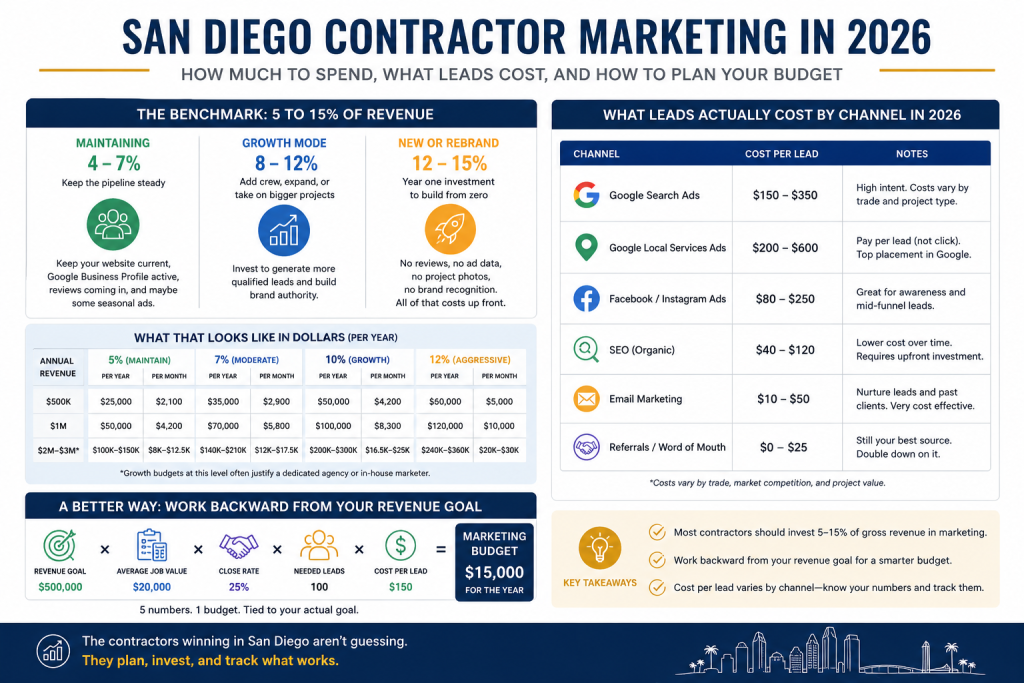
For most contractors, marketing spend lands somewhere between 5 and 15 percent of gross annual revenue. Where you fall in that range depends on one question: are you maintaining or growing?
If you’re established with a solid referral base and you just want to keep the pipeline steady, 4 to 7 percent is enough. That money goes to keeping your website current, your Google Business Profile active, your reviews coming in, and maybe some seasonal ads.
If you’re in growth mode, meaning you want to add a crew, expand your service area, or move into bigger projects, plan on 8 to 12 percent. New businesses or companies coming off a rebrand often need 12 to 15 percent in year one. You’re building from zero: no review history, no ad data for Google to optimize against, no photo library of finished work, no brand recognition. All of that costs money up front.
What That Looks Like in Dollars
A contractor doing $500K a year at 5 percent spends $25,000 a year, roughly $2,100 a month. At 10 percent in growth mode, that’s $50,000 a year, about $4,200 a month.
A contractor doing $1M at 7 percent has $70,000 a year to work with, roughly $5,800 a month. Push to 10 percent for aggressive growth and you’re at $100,000 a year, about $8,300 a month. At $2M to $3M in revenue, growth budgets of 8 to 12 percent start landing between $15,000 and $25,000 a month, which is the level where a dedicated agency relationship or marketing hire starts making real sense.
If those numbers made you flinch, that’s normal. Most contractors have never seen marketing framed as a percentage of revenue. But the companies winning the biggest remodels and design build projects in San Diego right now are spending in these ranges. You’re not competing against a benchmark. You’re competing against them.
A Better Way: Work Backward From Your Revenue Goal
Percentages are a decent starting point, but they treat a general contractor running 4 percent net margins the same as a plumber running 20 percent. The smarter approach is to set your budget backward from a revenue goal. Here’s the whole framework in one example.
Say you want $500,000 in new revenue this year. Your average job in San Diego runs $20,000. That means you need 25 new jobs. Your close rate on qualified leads is 25 percent, so you need 100 qualified leads to land those 25 jobs. If your blended cost per lead is $150, your budget is 100 leads times $150, which comes out to $15,000 for the year.
That’s it. Five numbers and you have a budget tied to an actual goal instead of a percentage you read in a blog post. Two warnings before you run it on your own business. First, San Diego project costs run 20 to 30 percent above the national average, so use your real average job value, not a number from a national survey. Second, if you don’t know your close rate or your cost per lead, that’s the first problem to fix, because you can’t manage a budget you can’t measure.
What Leads Actually Cost by Channel in 2026
Cost per lead is the number that makes or breaks the framework above, and it varies wildly by channel. Here’s where the benchmarks sit going into 2026.
| Channel | Cost Per Lead | Lead Quality | Time to Results |
|---|---|---|---|
| Google Local Services Ads | $30 to $150 | Very high, exclusive leads | Immediate |
| Google Search Ads | $100 to $350+ | Very high intent | Immediate |
| SEO | $40 to $120 once mature | High, you own the channel | 4 to 12 months |
| Meta and Facebook Ads | $15 to $150 | Medium, demand generation | Weeks |
| Lead aggregators (Angi, etc.) | $15 to $120 per shared lead | Low, shared and price shopped | Immediate |
A few things jump out of that table. Local Services Ads are the best kept secret for trades that qualify, including HVAC, plumbing, electrical, and roofing. You pay per lead instead of per click, the leads are exclusive, and Google screens you, which builds trust. Search ads cost more per lead but capture people actively looking for your exact service today. SEO looks expensive when you factor in the 4 to 12 month ramp, but once it matures, it produces leads at a fraction of paid costs and never stops. Aggregator leads are cheap for a reason: the same homeowner just got sold to four of your competitors.
Costs also shift by trade. Roofing is brutal on Google Ads, with cost per lead around $228, but one roof covers a lot of clicks. HVAC companies see Local Services Ads leads in the $51 to $55 range with some of the best return on ad spend in home services. Electrical is the cheapest trade to advertise, with LSA leads as low as $39 to $49. Remodelers get a different deal: clicks run a manageable $8 to $18 for high intent keywords, and mature SEO produces leads at $40 to $120, which is why content and search are usually the smart play for remodeling and design build firms.
One San Diego note on top of all this: clicks for competitive home improvement keywords here regularly run $30 to $80 or more. The same budget that dominates in Bakersfield buys a fraction of the visibility in this market. Plan accordingly.
Where the Money Actually Goes
Say you’re a remodeler or design build contractor doing around $1M and you’ve budgeted $5,000 to $6,000 a month. Here’s a realistic breakdown.
Website and SEO, roughly $1,000 to $1,500 a month. Your website is where every lead ends up before they call you. It needs to load fast, show your best work, rank for searches like “kitchen remodel San Diego,” and make it stupid easy to contact you. Hyperlocal matters here too. San Diego is a sprawl of distinct neighborhoods, and a contractor ranking for La Jolla, Poway, and Encinitas searches individually pulls leads a generic “San Diego” page never sees.
Content, roughly $1,500 to $2,500 a month. This is the part most contractors skip, and it’s the part that separates the companies winning $150K projects from the ones grinding on $20K jobs. Professional photos of finished work. Video walkthroughs. Testimonial videos with real clients. Reels showing the process. A homeowner spending six figures will study every photo and video you have before they ever call, and 97 percent of consumers read reviews before choosing a local business. Content and reputation are the trust layer everything else sits on.
Paid ads, roughly $2,000 to $3,000 a month including management. Google puts you in front of people searching right now. Meta puts your best projects in front of homeowners who are planning a remodel but haven’t started searching yet. Ads are your fastest lever, and also the easiest place to burn money, which brings us to the next section.
The DIY Trap
Plenty of contractors try to run this themselves, and the attempt almost always looks the same.
You post on Instagram for three weeks, get 11 likes per post, and quietly stop. The posting was inconsistent, the photos were rushed, and nothing connected it to actual leads. Social media without good content and a plan is busywork.
Or you set up Google Ads yourself. Google makes it feel easy, then the automated settings spend your budget on broad keywords and clicks from people looking for jobs at construction companies or DIY videos. At San Diego click prices, a poorly built campaign torches $2,000 in a month with nothing to show for it. That’s where most of the “I tried marketing and it didn’t work” stories come from.
There’s a second DIY failure nobody talks about: lead handling. Responding to a lead within 5 minutes makes you up to 21 times more likely to qualify them, and the industry average response time is over 14 hours. Most contractors are on a roof or in a client meeting when the lead comes in. The money spent generating that lead is wasted by lunchtime.
The problem usually isn’t the channel. Running marketing well is a full time skill set, and you already have a full time job running crews, managing clients, and bidding work.
What a Full Stack Marketing Partner Actually Handles
The typical alternative to DIY isn’t much better: one vendor for the website, another for SEO, a freelancer for social, a fourth running ads. None of them talk to each other. The ads point to a weak website. The social account has nothing to post because nobody is producing content. You become the project manager for your own marketing, which is the exact job you were trying to get rid of.
The model that works is one team handling the whole stack: content creation, website, SEO, ads, and social, all connected. The crew that shoots your projects feeds the social calendar. The same footage becomes ad creative. The website showcases that work and converts the traffic that ads and search bring in. One strategy, one point of contact, one monthly number.
Most agencies in this space only do SEO and ads, then ask you to supply the photos and videos. That’s backwards. Content is the fuel, and without it the rest of the machine has nothing to run on. That’s why at SDMP the anchor service is content: on site shoots, reels, testimonial videos, and project walkthroughs, all produced for you. You can see how the whole model fits together on our marketing for San Diego contractors page, and if you’re a smaller operation not ready for the full stack, our small business marketing page covers where to start.
The Napkin Math: How to Know If It’s Working
Forget followers and impressions. Three numbers tell you everything.
Cost per lead. Total monthly marketing spend divided by real inquiries. Spend $5,000, get 25 qualified leads, your cost per lead is $200.
Close rate. If you close 1 in 4, those 25 leads become roughly 6 jobs, meaning each job cost about $830 in marketing to land.
Job value. If your average job is $40,000, you spent $5,000 to generate around $240,000 in revenue. And that understates the return, because a happy client refers neighbors, comes back for the bathroom two years later, and leaves the review that closes the next stranger. Referral and repeat business is the cheapest acquisition channel you will ever have, and good marketing feeds it instead of replacing it.
Track those numbers by channel every month and move budget toward what’s working. Two timing rules while you’re at it. If your trade is seasonal, front load spend in the weeks before your peak instead of spreading it evenly across the year, so you’re visible when demand ramps. And don’t cut marketing the moment things slow down. Slow seasons are when competitors go quiet, visibility gets cheaper, and the contractors who stay in front of homeowners capture a bigger share of whatever demand exists. Cutting spend in a slow month is how you guarantee the next slow month.
Start With a Real Number, Not a Guess
Here’s the short version. Pick your lane: 5 to 7 percent to maintain, 8 to 12 percent to grow, more in year one. Or skip the percentage and work backward from your revenue goal using your average job value, close rate, and cost per lead. Put the money into a website that converts, content that proves your quality, and the ad channels that fit your trade. Then measure cost per lead and close rate monthly and give SEO time to compound instead of judging everything at 30 days.
If you want to see what that looks like for your specific business, with your trade, your revenue, and your goals, that’s a conversation worth having before you spend a dollar. Reach out here and we’ll walk through a real plan with real numbers, no pressure and no 12 month contract pitch.

